Feb 14, 2012 | Breakthrough Marketing
(Note: Viewpoint is a critical part of my Breakthrough Marketing Framework, to learn more about how it fits with Value and Velocity to create impact and breakthrough, read this post…Ken )
In my recent blog on High Impact Marketing, I said,
Viewpoint is a framing of the market in the context of your uniqueness. The uniqueness of your team, your capabilities, and your vision. Some call viewpoint thought leadership, some vision with a capital V, and some brand.
and I called on providers to set a unique and compelling viewpoint to create breakthrough for their marketing efforts.
While there are many frameworks and techniques to capturing Viewpoint, however defined, one of the simplest and most effective way I have, and one the first I usually pull out of my toolset, is to simple create an X and Y set of axis and coordinate labels for the market. A simple 2×2 matrix which will then set your view firmly in one corner of the world, the best one!
There’s a running joke in MBA circles that no presentation is complete without a 2×2 matrix. This dates back at least to 1968 and the classic BCG “Growth Share” matrix, which among other notoriety is the source of the phrase “Cash Cow”! With dimensions of market share and market growth, the BCG matrix provided a powerful way to understand and measure product segment profitability. This example illustrates just how powerful a 2×2 matrix can be in setting a framework in which to view a problem. From a simple idea, sprang a wealth of insight and business for BCG.
So let’s try applying the 2×2 matrix to the problem of articulating a market Viewpoint. Setting your market Viewpoint with a 2×2 matrix simple requires these “simple” steps:
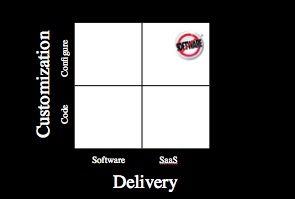
1) Identify the X-axis. A good place to start here is with the biggest and simplest piece of your market vision. For Salesforce.com, this was the transition from Software to Service (now called SaaS, then call nothing really). Now that we’ve identified the endpoints, name the Axis, in this case let’s call it “Delivery”
2) Identify the Y-Axis. Here let’s try the biggest change in the customer experience. In the Salesforce.com case, it is from Coding to Configuration. Let’s name that axis, “Customization”.
3) Claim the upper right corner as yours. Here’s how this comes together in the Salesforce.com example:
The “End of Software” became Salesforce.com’s viewpoint, mantra and vision. All from this “simple” 2×2 framework.
Viewpoint is all about framing the marketplace discussion, so you can then deliver your value to the customers who see through your market viewpoint. Salesforce’s value came in the proposition of lower TCO, faster Time to Value, and greater utilization than traditional CRM software packages. And while “the End of Software” viewpoint did not sell any customers, it set a powerful market context for Salesforce to define and own the emerging SaaS CRM category, and create their own cash cow business.
Jim Barksdale, former CEO of Netscape, and one of the most amazing bosses I’ve ever had once said,
“In the battle the bear and the alligator, the victor is determined by the terrain”
By articulating a compelling and meaningful viewpoint, organizations create the terrain so that they emerge winners.
Feb 8, 2012 | Breakthrough Marketing
Unless you are a hardcore (American) football fan, or happened to just catch the latest episode of HBO Real Sports, you may have never heard of Coach Kevin Kelley of Pulaski Academy in Little Rock Arkansas. But if you are a football fan, I’d imagine you may hear about him soon even if you forget about this blog. You see, Kelley’s teams haven’t punted since 2006. And in that time he has taken his small 350 kid school into the national top 100 rankings and to 3 state championships while winning well over 90% of his games…
“The average punt in high school nets you 30 yards, but we convert around half our fourth downs, so it doesn’t make sense to give up the ball,” Kelley says. “Besides, if your offense knows it has four downs instead of three, it totally changes the game. I don’t believe in punting and really can’t ever see doing it again.
and
He means ever. Consider the most extreme scenario, say, fourth-and-long near your own end zone. According to Kelley’s data (much of which came from a documentary he saw), when a team punts from that deep, the opponents will take possession inside the 40-yard line and will then score a touchdown 77% of the time. If they recover on downs inside the 10, they’ll score a touchdown 92% of the time. “So [forsaking] a punt, you give your offense a chance to stay on the field. And if you miss, the odds of the other team scoring only increase 15 percent. It’s like someone said, ‘[Punting] is what you do on fourth down,’ and everyone did it without asking why.”
So what’s going on here and what’s it got to do with this blog, SaaS and Product Marketing? I think quite a bit. Here’s why…
Despite the overwhelming evidence and success of his strategy (he also onside kicks on every kickoff and lets opposing punts roll un-fielded) and his growing popularity at coaches clinics and the like, it is not apparent that Kelley has attracted many disciples. He’s probably OK with that as he is amassing huge competitive advantage over his opponents. As the SI article continues:
Which is to say that most football coaches aren’t simply averse to risk—no shock, there—but that they make choices at odds with statistical probability, akin to blackjack players standing on 11. The explanation: Subject as they are to scrutiny, coaches have incentive to err on the side of conservatism.
This brings me full circle to one of my favorite topics and soapboxes, Experience Marketing. While conventional B2B marketing wisdom is that only very well qualified and vetted buyers should see demos or receive trials, without fail, in every scenario I have seen, the number one predictor of sales cycle success is the presence of a trial/POC or other real hands on experience.
Yet I see time and time again, sales and marketing teams in SaaS organizations, that could easily move the trial or experience to the front of the marketing and sales cycle, hang on to conventional wisdom, hiding or gating the actual product experience. Whether this is because of fear of failure or simple rejection of the new, or concern over investor or CEO second guessing, those in the old product mindset are punting away opportunity every day.
I have one thing to say to them: “DON’T PUNT – JUST GO FOR IT “. Whether that means a try and buy, freemium model or live demo instances, put EXPERIENCE front and center in your go to market strategy and tactics. IT WILL give you the Kelley No Punt advantage.
It’s no surprise that Kelley is out on the corporate speaking circuit talking about thinking outside of the box. It’s a simple recipe for winning. Look at the data. See it in a new way. Change your mindset. Have the courage to ask. Where else can cloud providers get a Kelley advantage…if you know, act now and win!
Jan 26, 2012 | Breakthrough Marketing
Most CEOs I talk to have a jaded, if not skeptical view of marketing. While they recognize the importance of marketing to their long term success, they have a hard time understanding and measuring how well marketing is doing. And while more mature organizations have a good handle on very well tuned marketing metrics and measurement, the question is still always out there. With the advance in marketing automation, new channels of communication, and the avalanche of marketing data now available, marketing has evolved, in many CEOs view, from a black art, to a black science.
Hidden behind the dashboards and metrics lies a more fundamental problem. In today’s hyper competitive, global, instantaneous market, where buyers and consumers have nearly unlimited access to information and each other, the fight for attention and share has become a treadmill of constantly faster speed. With the proliferation of social media, and competivite solutions in even the most specialized market segment, we need a new Breakthrough marketing formula to feed the machine.
Simply put, we need a new model for getting noticed and getting bought. To achieve the highest breakthrough possible, we need to get great at Viewpoint, Value and Velocity. We need to move to Converged Viewpoint, Unique Value and High Velocity.
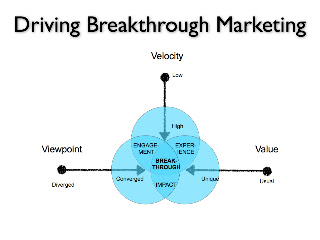 |
| Viewpoint, Value and Velocity Converge to deliver breakthrough |
Let’s look briefly at each of these elements, what they are, and why they are needed.
Viewpoint
Viewpoint is a framing of the market in the context of your uniqueness. The uniqueness of your team, your capabilities, and your vision. Some call viewpoint thought leadership, some vision with a capital V, and some brand.
Why is Viewpoint critical? Without a doubt, we live in a world of data and information overload. But often overlooked is the aspect of information over-availability. As anyone who use Google knows, the challenge is not in finding an answer or result, but it is in finding the right or most helpful one. What does this mean for marketers? Let’s take a look at one small experiment. In November of 2011, KJR Associates examined a sampling of companies from the Andreeson Horowitz venture portfolio; Here’s a screen grab of that set:

We then examined the websites of each company and determined its “market category”:
Finally, we did a Google search using the a quoted market category name and looked at the quantity of search results returned. This is displayed here:
 |
| Market Categories |
 |
| Google Search Result for Specific Results |
So, as is clear from above, and totally consistent with our intuition, it’s a CROWDED marketplace for products and ideas. Even in very niches market segments, we have hundreds of thousands of results returned. The ONLY way to be noticed in this market is to provide something different, a UNIQUE and RELEVANT viewpoint.
In order to define Viewpoint providers must tap into the macro trends that impact their customers, as well as the discontinuity they offer to meet these trends. In my related post on Viewpoint, I walk through an example of this process.
Value
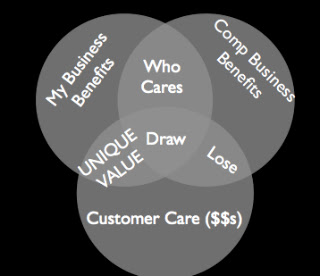
So while Viewpoint is critical to getting noticed, Value is critical to getting into the buyers shortlist. Simply put, Value is defined as the intersection between your unique capabilities express as business benefits, your customer needs, and the missing capabilities of your key competitors. This is shown with a simple sketch:
This unique Value is then articulated in forms such as competitive positioning statements, messaging, market segmentations and product feature benefit charts. Then when combined with Viewpoint, I can tilt the market in my favor. This process is further discussed here.
Velocity
With ViewPoint articulated and Value defined, the last piece of the puzzle is to deliver high velocity programs, those that deliver high quality leads across the buying lifecycle. Marketing Velocity = DE**2, or simply put:
Velocity = Delivery X Engagement X Experience
High velocity marketing is strong on message, meaning it effectively and creatively communicates Value within a powerful market Viewpoint. High velocity marketing uses appropriate Delivery channels and investments that meet buyers whereever and whenever they are in the buying lifecycle. More and more so, this is about delivering compelling experiences, as I have blogged about extensively. Lastly, high velocity marketing is fueled by high levels of interactivity and engagement. Gone are the days of depending solely on complex whitepapers to explain solutions. Vehicles like live demos, interactive assessments, and engaging video case studies are now a must. Velocity is further explored in this post.
In today’s high velocity market, we need a new HIGH BREAKTHROUGH marketing formula to feed the machine. High Breakthrough Marketing is a product of Viewpoint, Value and Velocity, or V–cubed! So, in order to deliver with velocity, organizations need to define a unique Viewpoint, articulate customer driven Value, and execute high Velocity programs. Without these 3 Vs, investments in marketing automation, content marketing and nurturing programs will deliver at best, mediocre results.
Dec 30, 2011 | Breakthrough Marketing
When I was a wet behind the ears sales rep in the Rolling Meadow’s Illinois branch office in 1986 (yes, they had computers back then :)), I remember the big sign that hung on the wall;
Calls + Demos = Sales
Now this office sold everything from PCs to copiers (yes, IBM sold copiers) to mini computers (S34, 36, 38, and later AS/400 and RS6000s) and the biggest S360 Mainframes. Though the sign belonged to the “Office Machines”, ie Copiers, team, I quickly learned in my territory of small manufacturers and distributors, the key to selling the minicomputer lay in not just having the right software package, but in putting a killer demo in front of the customer. As Jerry Maguire might say, “show me the money” and I say then and now, “show me the demo”.
Fast forward 25 years or so and I now have come to the corrolary to this sign for B2B technology vendors:
Marketing + Experience = Sales
As I have blogged about extensively, I believe that B2B technology sales and marketing is being transformed, as we move from products to services, we must move from traditional evaluation based product sales to experienced based service sales, this is true in SaaS models but in many other places too. In fact, just walk into any Apple store and see this in action, they are built to be giant experience labs, contrast that to the traditional cell phone store or Best Buy with product under glass covered cabinet shelfs or sitting tied down on turned off or canned displays.
Why is it then that B2B Software and SaaS providers continue to hide their experiences in the equivalent of a locked glass cabinet, behind weeks of qualification and sales calls that make a customer “prove” that they should be able to give it a go? Why not put the experience (trial, freemium, demo instance, whatever) front and center in your go to market?
I believe there are 3 main “reasons” for this hesitancy. They are:
1) The belief that the customer will not see enough “value” in the trial or demo experience.
2) The belief that my competitors will learn so much that this will put them at an advantage over us.
3) They simply haven’t invested yet (mentally or financially) in transforming their mindset, service and tactics to take advantage of experience marketing.
As you might guess, none of these reasons hold water for me. The first and second are simply outdated vestiges of the old way of thinking. If #1 is true, than shame on you for not delivering value, you best be fixing that regardless of your go to market strategy.
Reason #2 is just living in a fantasy land. First of all, a determined competitor will get a hold of your product or service, even if you spend a lot of effort and time to prevent it. Without passing judgement on tactics, I’ve seen shell companies, resellers, consultants and others to be effective paths for “back door” acquisition. It’s really not hard.
As for reason #3, rest assured, if you aren’t making this investment, one of your existing or soon to be competitors is. EVERY market is being disrupted and re-invented, you best be the one to do it to yourself. You can’t afford not to!
So with that I’d like to declare 2012 the “Year of Experience Marketing”…care to come along??
Jul 5, 2011 | Breakthrough Marketing
About 5 yrs ago, I had the pleasure of sitting through sales training with John Costigan. I remember John’s opening as he said something like, “How are you?” and got the typical quite reaction. John went on to say something like, “when I am asked, I say “OUTSTANDING” and you should too. Because to STAND OUT, you MUST BE OUTSTANDING”.
Fast forward to last week, when I was having a discussion on positioning with a very successful entrepreneur turned VC. He said, “the only way to win in today’s markets is to STAND OUT, create something new”. Immediately I thought of John and said to myself, “If you want OUTSTANDING positioning, you must STAND OUT from the crowd.”
When you look around B2B technology providers, those who do stand out usually take one of three fundamental approaches to differentiation, what I call 1+1=3, Embrace and Extend, and Copy and Paste. All can generate OUTSTANDING results and returns.
As Cloud computing goes mainstream, ISV, Hoster and other service providers can no longer depend on the previously successful, “We are X category, but as SaaS” such as early pioneers like Salesforce.com did. To truly STAND OUT and poke above the clouds, these three strategies offer proven paths to success.
1) 1+1=3 or Market Consolidation – Simply put, this is a strategy of adding together existing, adjacent capabilities in order to consolidate markets.
KJR client Nimsoft (now a division of CA) changed the IT monitoring market early on in the “Cloud era” by providing one product to consolidate the monitoring of Datacenter, Service provider and Cloud infrastructure, as I have blogged about extensively in this space. Market consolidation is an effective differentiation strategy because it provides clear value to the end buyer in cost savings and operational efficiencies.
Embrace and Extend – Next Generation X – The strategy of having competitive parity to existing capabilities and adding high value new ones.
Palo Alto Networks has created very rapid growth and disruption in the mature firewall space by embracing and extending the mature enterprise Firewall market with their “Next Generation Firewall” , not only consolidating the Firewall and IPS markets with their positioning, but by redefining the vary essence of a Enterprise Firewall to be Application and User centric, not port and protocol based. Their new App-ID and User-ID technologies changed the Firewall market dramatically, and gained them real first mover advantage over the incumbents. Embrace and Extend is effective because while disruptive, it goes after existing category dollars.
Copy and Paste – Stealing from other less related markets to create something
NEW!
While Embrace and Extend disrupts existing markets, Copy and Paste creates new ones. Success Factors copied KPIs from financial and capital management systems and created a Human Capital Performance management market. Splunk copied “search” from Google and the Internet to create the “IT Search” positioning that has made it unique and sustaining. Copy and Paste works because the value of the positioning is easy to explain and apply to new markets. Copy and Paste is a great way to position and explain disruptive technologies, and creates new spending rather than consolidation or taking existing category dollars.
So as you look for stand out positioning, leverage 1+1=3, Embrace and Extend, and Copy and Paste as three effective paths to rise above the clouds and generate outstanding returns for your company.
May 26, 2011 | Breakthrough Marketing
I am constantly surprised at how much my 4 kids teach me, but sometimes it’s really cool!!!
Owen, my youngest is a typical 3 1/2 year old boy, energetic, physical and fearless. He’s been riding on a glider bike for the last year, and loves to blast down hills with his feet in the air, scaring the daylights out of his Dad.
For those of you unfamiliar with glider bikes, it’s basically a pedal-less 2 wheeler that you propel like a scooter with your feet. I’ve been watching him scoot around on his glider wondering how he would do with pedals, would he need training wheels at all?? Would he be faster than his 3 older siblings at getting on a “real” 2 wheeler? (they all transitioned from training wheels at ages between 5 and 6, one with virtual ease, one with a few tries and one with 6 months of struggle. )
On Tuesday this week, the answers became clear. Owen said, “can I ride Addie’s bike?”. I said, OK sure. Owen hopped on, I gave him a little push and he was off pedaling, with the balance already second nature. Amazing, 3 1/2 and riding a two wheeler already with NO teaching, no back breaking run alongs, no leaning the wrong way for balance.
So, what did I learn? First I kicked myself for not having glider bikes for the other 3, oh well. Second I marveled at the effectiveness of learning balance and pedaling separately, and how it eased the transition in a way that training wheels fail miserably at. Third, I learned that the boy is crazy fearless, but I kinda already knew that from his accumulated trips to urgent care and many other sorties in playgrounds and parks.
This episode got me thinking about transitions, especially ISV to SaaS transformations, and how to ease the pain and difficulty. Certainly, doing this requires a good deal of fearlessness and courage to change mindset, organization and tactics, as I’ve blogged extensively about. However, I think most organizations can find a glider bike or two to help speed the transition and avoid losing organizational balance in the process.
For example, one client of mine who has been incredibily successful with this transition, was already selling their product in subscription mode 90+% of the time. Perpetual to Subscription is a huge and often challenging business problem. However, for this client, it became a glider bike to SaaS. Pricing drives many sales and customer behaviors, my client rode this glider right into the SaaS model.
Another glider bike to SaaS might be your go to market model. Do you focus on customers getting a taste of your product through download or guided demos? This focus on direct product experience can be your glider bike to SaaS success.
What other glider bikes are out there to help speed this business transition? Would love to hear your stories…
In the meantime, we will be shopping for a new bike for Owen this weekend, and hopefully not going to urgent care!!!
Cheers
Ken