Apr 10, 2013 | Breakthrough Marketing
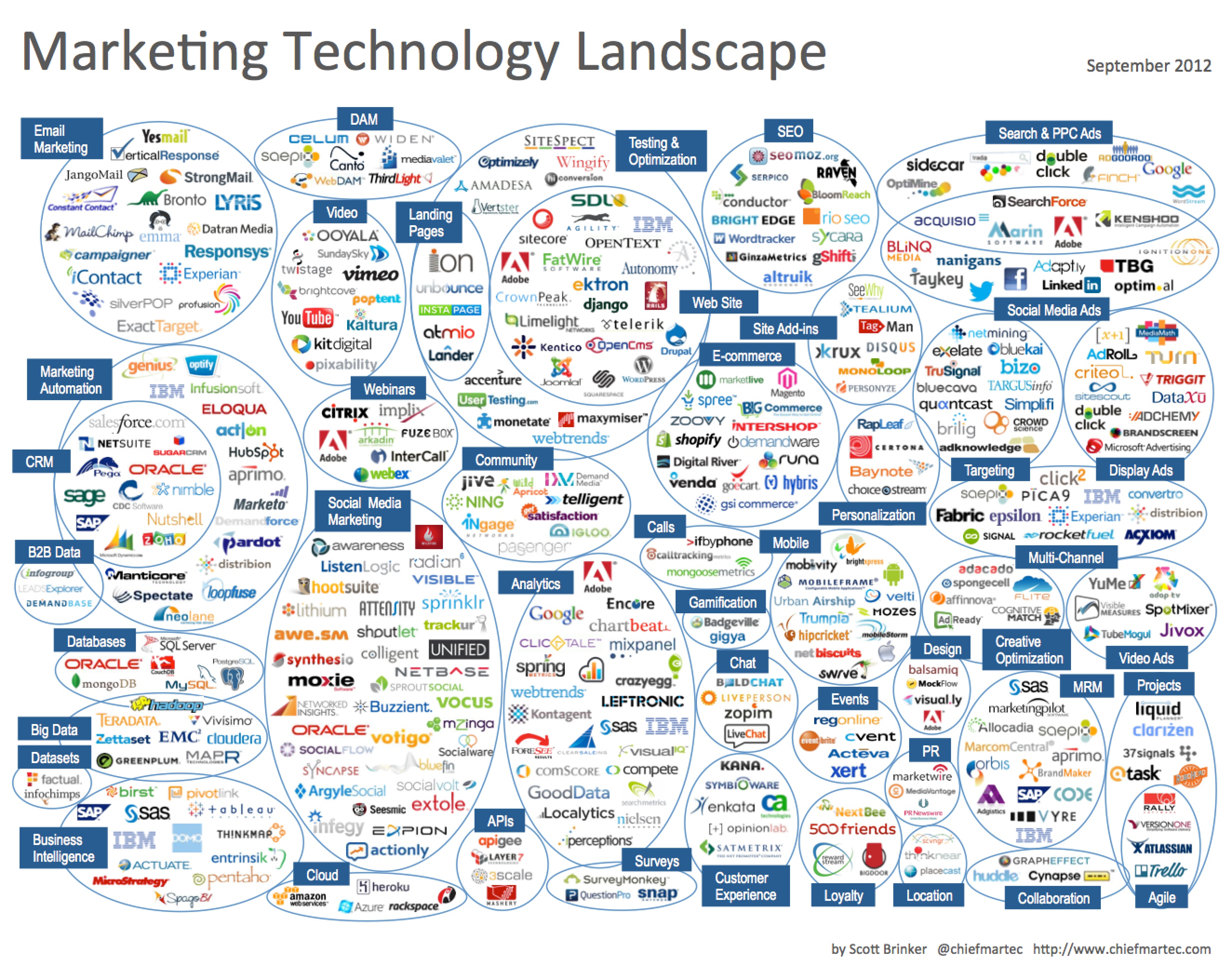
As I’ve blogged about here, marketers, especially high tech B2B marketers always overvalue value. We tend to be enamored with the feature, function and benefits of our products and services. And while I don’t want to rehash the five reasons I’ve previously outlined, I’ve come to realize that there is a FUNDAMENTAL flaw in our approach to communicating value. You see, at the end of the day, there are really only 3 (or 4 depending on how you count) benefits our products can deliver, Cost savings, revenue increases, and compliance improvement / risk reduction. These are great, but the problem is, the buyer is overwhelmed with products and investments that have positive ROI and offer compelling business cases. To see just how overwhelming this can be, take a look at this “Marketing Technology Landscape” by Scott Brinker. The bad news here, if your selling to the CMO and his team, you not only compete with the products in your space, you compete with EVERY VENDOR on this chart for priority and budget.
Business case is a MUST have, but NOT enough. The only way we win, is not only to present a compelling business case by defining our value well, but by raising the priority of our solution into the top tier, the ones that can get funded and executed. In order to do this, we must be STRATEGIC, not just VALUABLE. This is why context, or VIEWPOINT is the critical first step in our market conversation. By creating a strategic context for our value, we float to the top of the priority list. That’s what I call IMPACT. For more on the overall framework, see this blog. In the meantime, broaden your horizon to not just think about value, but to think about how to make your value the one that gets realized.
Mar 25, 2013 | Breakthrough Marketing
Salesforce, the granddady of them all in Cloud Computing, has shifted Viewpoints again.
On August 31st of 2011, Salesforce announced the “Social Enterprise” -” Our social enterprise vision fundamentally changes how companies collaborate, share and manage information,” said Marc Benioff, chairman and CEO, salesforce.com. “By creating social customer profiles, employee social networks, customer social networks and product social networks, companies can delight their customers in entirely new ways.”
At the time, many of us thought hmmmm, are Salesforce’s customers really in tune with this. I was willing to cut them some slack as I saw this as a try to create some space now that the “end of software” really was no longer effective context for their Viewpoint to be impactful. At the height of Social media buzz, Salesforce was saying to customers, “Social is the future and we will get you there”.
Now, just 18 months later, it appears that the “Social Enterprise” has made way for “The Customer Company” . Announced this month, Salesforces boilerplate now reads:
“Founded in 1999, salesforce.com is the enterprise cloud computing leader. Salesforce.com’s social and mobile cloud technologies enable companies to transform into customer companies by connecting with their customers, employees, partners and products in entirely new ways. Based on salesforce.com‘s real-time, multitenant architecture, the company’s apps and platform revolutionize the way companies sell, service, market and innovate.”
So what’s going on here? Here what I think. First, it’s clear, that the end of software was not meaningful. But I think this new shift confirms that “The Social Enterprise” just didn’t resonate with customers. I think it’s because it was WAY too Salesforce centric, and just didn’t mesh with the day to day reality of the customer’s world. While there may be a shift in enterprise computing to “Social”, it’s not keeping Salesforce’s customers up at night or getting them excited to get out of bed. At the end of the day, “The Social Enterprise” was more aligned with Salesforce’s product and corp dev roadmap than it was with customer thinking.
This brings us to “The Customer Company”. In the KJR Viewpoint Framework, Salesforce is trying to move from a “Better Mousetrap” to a “Brave New World” , if you leverage us, you can become a Customer Company. Salesforce rode “The End of Software” through more than a decade of growth, an IPO and stunning success. Staying at the leading edge of Viewpoint is not easy, and at scale, Act 2 is much harder than Act 1. The Customer Company is try number 2. I think this is a step in the right direction. However, it still seems focused on what Salesforce WANTS their customers to become versus what they BELIEVE THEY NEED to become. Time will tell.
Mar 15, 2013 | Breakthrough Marketing
Introduction
This is part 3 of a 3 part series on the mechanics of building Breakthrough Viewpoint. This series is a “how to” guide to creating the 4 types of Breakthrough Viewpoints as described in this post – Trendspotting, Better Mousetrap, All Pain No Gain and Brave New World. In part 1, we used the STEEP framework to describe the customer’s new world and label the Trendspotting point A in figure 1 below. In part 2, we used the KJR AIM™ Framework to describe our Re-imagined and Unexpected solution to then label our Better Mousetrap Viewpoint, point C on our framework. In this post, we will look at the intersections points of STEEP and AIM and label the “All Pain No Gain” and “Brave New World”, points B and D below.

KJR’s Viewpoint Framework.
Point B– All Pain No Gain. Having described out customers world, and our solution in terms of shifts in reality and expectations respectively, we can now powerfully combine the two. Point B is the intersection of the today’s reality with the expected solution. This articulation focuses on the pain and/or missed opportunity of trying to solve today’s big problems with yesterday’s solutions. Describing this goes something like, “in today’s reality of X, if you depend on the solutions you expect like Y, you are left with a big problem(s), tremendous missed opportunity, or both” This works great when the pain is large enough to induce action, and is well recognized and acknowledged, yet unaddressed. As as example, Security solution providerFireEye talks about the Advanced Malware Threats and the resultant risk to create a compelling context for a discussion of their solution. They have experienced explosive growth and are reportedly poised for an IPO .
Point D – Brave New World. The final viewpoint articulation is the intersection of today’s reality with our re-imagined and unexpected solution. This Viewpoint describes the promised new state that the customer can arrive at if they implement your solution. It is powerful because it talks about the intersection of the customer’s world and the providers unique solution. It is articulated like this, “In today’s new reality of X, if you have a solution that provides/does Y, you can achieve this Brave New World we call Z”. KJR client DMTI Spatial has established a new Viewpoint called “Location Economics”. DMTI is challenging their customers to find new opportunities to build business and reduce risk by recognizing the power of tapping into today’s Mobile Society with DMTI’s powerful transaction enablement services, re-awakening a staid and conservative data oriented market. Their articulation goes something like this, “Today we live in a mobile society. The movement of people, things and information creates both opportunity and risk. If you can integrate location information that is timely and accurate into your critical business and customer facing transactions, you can unlock the power of Location Economics, increasing revenues and reducing risk.”
In summary, we have now walked around the KJR Viewpoint Matrix, and seen the process of articulating 4 types of breakthrough Viewpoints. By applying this framework to your marketing positioning and messaging, you can breakthrough the the clutter of information overload, grab the attention of prospects and buyers, and earn the opportunity to set the stage for high velocity marketing and sales execution. The power of a Viewpoint sets the stage for your go to market success.
Feb 25, 2013 | Breakthrough Marketing
Introduction:
In part 1 of this blog series on Viewpoint, we explored the Y axis of the KJR Viewpoint framework, repeated below

and discussed using the STEEP analysis method to label the Y-axis and defined point A, the “Trendspotting” Viewpoint. In this blog, we will work on labeling the X-axis and look at how to describe point C, “the Better Mousetrap” viewpoint. Then in the part 3, we will put these together to reach our point B, ” All Pain, No Gain” and our point D, “Brave New World” viewpoint.
Ready, AIM™, Viewpoint!
It might seem trivial and simple to express what is “re-imagined” and “unexpected” about our product or service. In fact, that’s why we love our product. Some of the best products in the world are built by people who had a problem because of the the “Today’s Reality and could not solve it with the “usual” solutions available. So they built a “Better mousetrap” and then said, “Hey, if I could use this, I bet a lot of people could”. THE PROBLEM is, they tend to sound like this…
When I worked at Acme, we were faced with a situation where our protocol for X was incompatible with our current business solutions. What we really needed was a feature that we call FOO that integrates the existing infrastructure with the emerging need for cross channel communication and is compatible with …That why we built this new dweelybopper, obvious, right?
When they need to sound more like:
When I worked at Acme, we were faced with growing margin pressure, increased regulatory scrutiny and a process for Y that was not responsive and was too costly. Not only that, it was totally isolated from our current process, leaving us with un-substainable cost and compliance trade-off. What we really needed was a new approach that was people, not technology driven, and started with a whole new mindset that we could increase compliance AND reduce cost. Once we understood that, we knew if we only had an innovation like FOO that allowed us to … That’s why we built this new dweelybopper ..
Notice the subtle difference, we are not just telling the what:
- The Foo enabled Dweelybopper”
But we have been much more explicit about the why from our STEEP analysis
- leaving us with un-substainable cost and compliance trade-off
And most importantly we are focused on the not just on one, but on the three hows:
- The Approach – people, not technology driven
- The Innovation – the foo
- The Mindset – that we could increase compliance AND reduce cost
By crisply articulated the Approach, the Innovation and the Mindset, we not only create a context for our innovation, but we make it DRAMATICALLY more deep, compelling and interesting, exactly what we AIM to do!
We can think of this in a simple triangle framework:
 |
| KJR’s AIM Framework Describes Solutions By Approach, Innovation and Mindset |
By casting our innovation in multiple dimensions, we bring it to life, add memorability and create breakthrough. Our innovation is no different, but by spending the time talking about our approach and mindset, more and more people who will care and remember. So, when we want to talk about our “Better Mousetrap”, it’s not enough to describe it technically, we MUST talk about the why and the other two hows of approach and mindset.
In the next blog, we will combine the STEEP and AIM axis of the Viewpoint framework, and find the powerful Viewpoints at points C and D of our framework, “All Pain, No Gain” and “The Brave New World”.
Feb 22, 2013 | Breakthrough Marketing
Introduction
In my previous blog, Standing out – 4 Types of Viewpoint That Can Get You Noticed I discussed how to find 4 spots on my Viewpoint Framework that can powerfully set you apart in the market and get you noticed. The framework looks like this:
where we labeled point A “Trendspotting”, point B “All Pain No Gain”, point C “A Better Mousetrap” and point D “A Brave New World”. We then gave examples of each of these. However to build a powerful Viewpoint, you need to be able to EFFECTIVELY describe the 4 axis labels on the chart. On the Y-axis, we have “Yesterday’s Reality” and “Today’s Reality”; and on the X-axis the usual and “Usual and Expect” vs. the “Re-imagined and Unexpected” solution.
In part 1 of this 3 part blog series, we will look using STEEP to build the Y-axis labels and the “Trendspotting” viewpoint. In part 2 we will use KJRs AIM framework to build the the X-axis and “Better Mousetrap” viewpoint. In part 3 we will put them together to create the “All Pain, No Gain” viewpoint and the “Brave New World” viewpoint.
Getting STEEP
Most business people are well aware of the SWOT analysis framework to assess the Strengths, Weaknesses, Opportunities and Threats of a company, product or strategy. However far fewer have heard of STEEP (or its first cousins PEST, STEEPL, STEER, and PESTEL). STEEP and its derivatives and excellent tools to scan an environment to understand it. Perfect for our “Customer’s World” axis to define “Today’s Reality”. STEEP stands for Social, Technological, Economic, Environmental and Political. To keep it simple, we will include Legal and Regulatory in the Political sphere. (Now you see where the cousins come from!)
Most solution providers will focus on ONE of the STEEP factors when they think about their customer’s world. Bankers think about Economics, Environmental consultants think about Environment, Technology providers about well, duh, technology. This myopic view of the customer’s reality is self serving and self defeating. STEEP is an excellent tool to open our eyes and find trends that we might otherwise miss.
STEEP is simple.
- We gather our customer experts, and even some friendly customers, and brainstorm a list of the top 3-4 issues or opportunities or facing the customer in each of the STEEP area.
- We then rank order them by importance to the customer. We define importance as the degree to which the item matters to either risk or opportunity to the overall business.
- Once we have identified the top 10 of these items, we then rank order these factors into the top 5 that our solution can have positive impact on. Such as E: Segment specialization P: Increased privacy regulation and T: Mobile device proliferation among customers
- We then define the “Old Reality” as the opposite set of points so we can make statements like, E: “It used to be that Our (customer’s) industry players were 1 stop providers of broad solutions, however, there is a big move from consolidation to segment specialization” and P: “We are under ever increasing regulatory scrutiny on privacy of customer information, where we need to change from our standard of care and process oversight ” and T: “Our customers are demanding self service support and renewals on mobile devices”
- We then “add” these Statements together to form a Trendspotting label. For example, Zuora added a compelling set of trends together (Economics: Advantage to buyers and seller of pay as you use models, Technology: SaaS and Cloud Environmental: Ridesharing, etc…) and labelled them “The Subscription Economy” They describe it at http://www.zuora.com/subscription-economy/ like this:
Commerce has evolved. In the last 10 years, there’s been a dramatic shift in the way both consumers and companies want to do business. Today, people would rather subscribe to services than to buy products. It’s happening everywhere. And it will have a dramatic effect on your business
Stepping back and viewing the customer’s reality through the lens of STEEP is an exercise that can pay off in many ways, including creating a powerful Trendspotting viewpoint.
In part 2 of this series we will take “AIM” (Approach, Innovation and Mindset) at the x-axis of the framework to help create a more compelling articulation of our “Better Mousetrap” and then in part 3, we will look at the two powerful intersection between our STEEP and AIM analyses, “All Pain No Gain” and “A Brave New World”.
Feb 5, 2013 | Breakthrough Marketing
(Ken’s note: This blog is part of a series of blogs on Viewpoint. After reading this introduction, you may want to check out my step by step guide on developing your Viewpoint, a 3 part series of blogs called – AIM STEEP to Build Breakthrough Viewpoint.)
As I’ve blogged extensively about, today’s information rich and overloaded environment, combined with independent buyers, make getting noticed harder than ever. Customers live in their world, not the vendors. When organizations struggle with filling the top of the funnel with engaged prospects, it is almost always a lack of getting themselves noticed.
My Viewpoint framework, shown below and developed over the last 4 years in helping clients reach new speed and success in building top line growth and filling the top of the funnel, is based on the simple yet powerful observation that buyers notice when you align your context or Viewpoint with theirs. This can be seen on the KJR 2×2 Viewpoint matrix here:
 |
| KJR’s Viewpoint Framework Aligns Your Solution With The Customer’s Reality |
To create a compelling context for our marketing message to breakthrough, we must articultate a Viewpoint, a top of funnel message, that aligns with the customers world, by placing our bet on on of the four locations on the matrix, labeled below as A, B, C and D. Let’s take a look at each of these Viewpoint types, label them, and look at the characteristics of and an example of each.
 |
| There are Four Types of Viewpoints that Can be Effective |
|
Viewpoint Type A: Trendspotting. This articulation of a Viewpoint is powerful in that it names and frames a environmental shift that is either keeping the customer up at night or creating great opportunities for them. Zuora coined “The Subscription Economy” effectively owning the name of the megatrend that was engulfing the business world, and have built a highly effective go to market strategy around this articulation.
Viewpoint Type B: All Pain No Gain: This articulation focuses on the pain of trying to solve today’s big problems with yesterday’s solutions. This works great when the pain is large enough to induce action, and is well recognized and acknowledged, yet unaddressed. FireEye talks about the Advanced Malware Threats and the resultant risk to create a compelling context for a discussion of their solution. They have experience explosive growth and are poised for an IPO according to their CEO.
Viewpoint Type C: A Better Mousetrap: If you know you have a problem, and are spending money to fix it, but either have not eliminated the problem, this positioning leads with, “Hey, what you have sucks and I’ve got a better solution here.” This Viewpoint works great in replacement markets. For Example, Palo Alto Networks took their “Next Generation Firewall” viewpoint to the bank to the tune of a $3+B IPO right around the backs of Checkpoint, Fortinet and others. And while arguably those others have caught up with feature sets, Palo Alto is still viewed as the gold standard of the next generation of firewalls.
Viewpoint Type D: A Brave New World: This type of Viewpoint describes the promised new state that the customer can arrive at if they implement your solution. It is powerful because it talks about the intersection of the customer’s world and the providers unique solution. KJR client DMTI Spatial has established a new Viewpoint called “Location Economics”. DMTI is challenging their customers to find new opportunities to build business and reduce risk by recognizing the power of tapping into today’s Mobile Society with DMTI’s powerful transaction enablement services, re-awakening a staid and conservative data oriented market.
All four of these types of Viewpoints can make you stand out and get noticed, creating excellent context for your Go to market and content marketing activities.
NEXT STEP: For step by step guide on developing your Viewpoint, see my 3 part series of blogs called – AIM STEEP to Build Breakthrough Viewpoint.