Dec 4, 2017 | Breakthrough Marketing
Last week proved once again that the cybersecurity market is alive, well and kicking for investment activity and returns. Three transactions of significance happened last week and now that we’ve caught our breadth, let’s take a look at what we can learn. First, in case you were on vacation or not watching the market
- Barracuda is being acquired (NYSE: CUDA) by private equity investor Thomas Bravo for an all cash deal of $1.6B, a 16.7% premium on the pre-announcement share price.
- KJR Client Skyhigh Networks is being acquired by McAfee for an undisclosed amount. According to publicly available sources, the private funding of SkyHigh was at a valuation of $400M. And while I have ZERO insider information, one would assume McAfee paid a decent if not large premium over that funding valuation.
- Another lesser known KJR Client, Weblife.io made big news when it was acquired by Proofpoint (NASDAQ: PFPT) for $60M. According to Crunchbase, Weblife had only raised about $3.5 M in venture funding, well done!
So, what lessons can we learn from this. First some of the obvious ones
- Investors love software, especially high growth companies. Just compare the financials of Barracuda and Proofpoint. Barracuda has last 4 trailing quarters of about $280M in revenue and are profitable, but revenue growth is flat and profit down in last reported earnings. Proofpoint on the other had, has about $350M in last 4 quarters of revenue but with incredible growth from $76M to $98M quarters in Q416 and Q317 respectively. But, they are still not yet profitable. However, the market loves software and rewards growth, and Proofpoint’s market cap sits at nearly $4B, more than double that of Barracuda. (BTW, these companies sell similar solutions, Barracuda’s being hardware mostly hardware based and Proofpoint’s being software and SaaS, but Proofpoint is also more of an Enterprise provider, and Barracuda a small to medium business one)
- Security vendors that can grow can take advantage and consolidate other complementary solutions. Proofpoint has a great currency and is buying up smaller tuck-in solutions at a rampant pace. The company also closed their $110M Cloudmark acquisition last week. Security vendors that can grow can take advantage and consolidate other complementary solutions.
- Early stage security solutions can yield big returns for investors. As noted Weblife.io only raised 3.5M, with their seed funding barely 2 yrs ago. Clearly, Proofpoint saw something in their solution, their story and their traction that was very attractive to them. Some of the competitors in the broader “web isolation” category that Weblife is part of have raised 10x or more than Weblife and while still early, seem to be struggling to find a path to liquidity. Simple formula, find a problem, solve it, and sell it to customers, but do so without massive fundraising and your outcome can be great.
One other factor I must point out, and this one may not be quite as obvious, is the value of story in building, capturing and gaining market leadership and investment returns, which is how I helped both Skyhigh and Weblife.
- Skyhigh’s original launch positioning centered on Shadow IT is a perfect example an “All Pain No Gain” story as discussed in my book, Launching to Leading. This story, launched at RSA in 2013, allowed them to claim, grow and be recognized as the leader in a new market segment call Cloud Access Security Broker, or CASB for short. The outcome speaks for itself!
- Weblife’s positioning around Securing, Empowering, Simplifying (Employee Web Access) demonstrates the value of what I call “A Brave New World” outcome in Launching to Leading. And it is also an excellent example of moving beyond feature function and benefit and focusing on value in order to tilt the market to your solution.
I’m very proud of the work that I did at Skyhigh and Weblife. As they say, success has a thousand authors, and I am happy to just take my 1/1000th portion of credit for their success, as I know that they did at least 999 more things right to get these outcomes. But story matters, and these are two great proof points (pun fully intended) to prove just that!
Jun 22, 2017 | Breakthrough Marketing
A client of my recently lamented, “I was really hoping we’d find a silver bullet”. I asked her what she meant. She said, “You know, the ONE thing we could say, the one sentence that would set us apart”.
I said, “Well, there might not be a silver bullet(yet), but we’ve got a Golden Story!”. The story that connects your uniqueness to the customer’s context and creates market opportunity and leadership.
The Golden Story has 4 bullets in its magazine, they are:
- Your world has changed Mr/Mrs. Customer, and here’s what TODAY’S REALITY IS
- If you keep trying to solve your problems with the expected solutions, you will be THIS PAIN and/or MISSING THESE GAINS
- What if you SHIFT YOUR MINDSET AND APPROACH to solving your problems?
- Then you could be in a TRANSFORMED AND BETTER FUTURE REALITY
I also call the Golden Story your Viewpoint story. Notice who this story is about, NOT YOU! It’s about your customer. And here’s the really cool thing about it, that tag line, that one sentence, that catch phrase silver bullet, like Salesforce.com “End of Software” or Nike’s “Just Do It” often will emerge as you tell your Golden Story.
So forget the silver bullet and you’ll probably just find it hiding in your Golden Story, which I am happy to report, my client seems to have done as we revised and reviewed their story!
For step by step on building your Golden Story, read my book, Launching to Leading!, or even better, attend Viewpoint Story Hackathon and we can build it together!
May 3, 2017 | Breakthrough Marketing
Product – Market Fit is an important concept in very early stage start-ups. It is the thing that is perceived by founders and investors alike as THE milestone to signify that customers want the product and it is time to accelerate growth investments. As Marc Andreessen is quoted as saying, “Product/market fit means being in a good market with a product that can satisfy that market”. Blogger Sean Ellis (@seanellis) of GrowthHackers.com defines Product Market Fit as the time when 40% of your initial customers say they would be “very disappointed” without your product. Netscape’s CEO Jim Barksdale said it in a bit more folksy way, “It’s not dog food if the dogs don’t come off the porch and eat it.” Product market fit, implies that it is indeed dog food that’s in your dog food can. So, now, we gotta let the dogs know it’s time to come and get it.
However, as Dan Olsen (@danolsen), author of The Lean Product Playbook, discusses in this slideshare entitled, “How to Achieve Messaging-Market Fit” Message-Market Fit is determined by “How appealing the messaging sounds” to the customer, not by how well the product meets their needs as in Product-Market Fit. Dan goes on to give a good primer on the basics of good messaging and positioning.
In my book, Launching to Leading, I dive deeply into the market leadership life-cycle and what that leaders must do to breakthrough and lead. Here, let’s use the lens of Message-Market fit to frame this discussion. There are three levels of Message Market fit that you must achieve to lead and win your market. Let’s call there Level I Value Fit, Level II- Unique Value Fit and Level III – Viewpoint Fit. Moving through all 3 of these levels is necessary as you grow from launching to leading your market. Let’s take a quick look at these three levels.
Message Market Fit Level I – Value Fit – When we launch and start to invest in growth marketing, many are at a Level 1 Value fit. Value fit means we have articulated a set of benefits that our initial set of customers are willing to pay for. And that this value is greater than the cost of acquisition and ongoing use or implementation of the solution, it has a positive ROI. Unfortunately, at this level of fit, we are only launching into the market, we are not yet moving toward leadership. To begin to participate in shaping and leading the market, we must move to a Level II message market fit, Unique Value.
Message Market Fit Level II – Unique Value – To achieve this level of Message Market fit, we must move from Value to Unique Value. Unique Value are the benefits we can deliver to the market that the competitive alternatives, be they other products, services, build you own, or do nothing, can not. And these Unique Values must matter more to the customer than any Unique Values that our competitors can deliver. And, this is NOT a feature discussion, it is a benefit one. Unique Value is the first time we begin to establish our participation in the market as a leader. This level of fit is how we win competitive deals, but it can be expensive, bloody street fighting. To really breakthrough and lead, we must move to Level III of Message-Market Fit, Viewpoint Fit, and in doing so we tilt the entire market battle in our favor.
Message Market Fit Level III, Viewpoint Fit – This level of Message Market fit operates at a level above the other two, that of context as opposed to direct benefit. When we achieve this level of fit, we answer perhaps the most challenging question of all, why should customers listen to us in the first place. How do we rise above the cacophony of noise in the marketplace to get attention so we can communicate our Level II Unique value to more and more receptive prospects?
Customers live in their context, not ours. To achieve Level III Message Market First, we must relate our uniqueness to the customer’s world. We must show them why we matter, and why our mattering aligns to their world and it’s challenges and opportunities. We should them how our unique approach, our mindset, our innovation aligns with their world and how it can be the magical power that can make their world so so much better. I call this telling your Viewpoint Story, and you can read more about how in the detailed blog series here.
Market are conversations. These conversations are framed in the customer’s world and in the known approaches to solving their problems. By starting our conversation with prospects with a Viewpoint anchored in their world, we raise our importance, breakthrough, AND actually can grow our Unique Value. Leaders with Level III Message-Market fit start and end their stories with the customer and their reality.
Product-Market fit is a necessary first step to growth. However, without paying close attention to Message-Market fit, and driving through the 3 levels of Message-Market fit, companies will stall and fail to grow despite having a product that fits the market. And who wants to join the set of companies who solve a problem but fail to matter.
Mar 10, 2017 | Breakthrough Marketing
New Math: 7 – 1 = 3. Stick with me here all you quant types!
How many times have you seen this drawing in a piece of marketing?
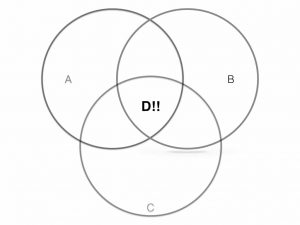
And the pitch goes something like this, “We are the only ones who can give you D, which is super amazing, because only we have A, B and C, everyone else only has A and B. ”
This logic seems OK, but it is very susceptible to the simple counter attack, which goes like this, “Our A and B are different, and we get you D too, just a different way.” Now we are in a total “she said, he said” argument. And for no reason, we’ve missed a key opportunity to make our differentiation.
The trick is the power of the intersections. Here’s what I mean, we need to name the 3 other intersections in our diagram, as shown here:
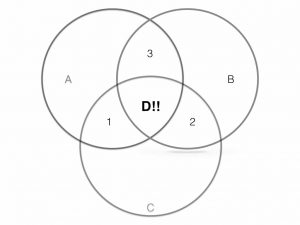
So, you see that 1+1+1 = 7, 7 not 4 items on the drawing. Then we can say, to get D, you need 1, 2 and 3. So if you take C away, you only get #3. Hence, 7-1=3. You not only lose C, you lose 1, 2 and D.
OK, this is a bit confusing, so let’s look at an example from my book Launching to Leading. In Launching to Leading I describe the Modern Marketing Machine as a Racecar, with Marketing Automation the Engine , Content Marketing and Programs the Wheels, and Messaging and Positioning the Fuel. It looks like this:
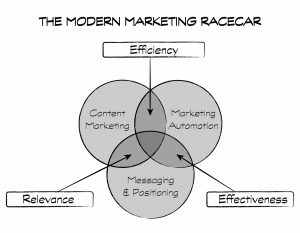
Notice the labels of Relevance, Effectiveness, and Efficiency. And now I quote with editorial liberty from the page 26 of my book, “As we see from the diagram, being great at content marketing and Marketing Automation and Content Marketing will make you efficient, but it will never get us to relevancy and effectiveness, and to be a market leader we need all three.” Given that my business is helping clients build their Racecar, and my secret sauce is my messaging and positioning frameworks, you can see exactly how the subtraction of great messaging and positioning is a 7 – 1 = 3 scenario.
7 – 1 = 3 is a powerful way to differentiate and deposition your competition. Read more about this and other messaging and positioning strategies in Launching to Leading, or contact me and we can see if we can put some new math at work for you.
Oct 19, 2016 | Breakthrough Marketing
(This is a continuation of a multi-part post on igniting and leading a market Movement. To start at Part 1, go here. )
Purpose or Movement Messaging, as I describe in Part 1 of this series, must either transform or inspire a business issue or society. With the 4 types of message, inspiration or transformation, business or societal, we see how this message reaches above market context, to provide an even bigger purpose to our messaging. In this post, I will show how my Viewpoint framework can be extended to also define a Purpose or Movement message.
Let’s take a quick look at the KJR Viewpoint framework as described in detail in my book Launching to Leading. The Viewpoint framework tells a story that starts in the customer’s current reality, taking them in three steps to a Brave New World. The Viewpoint Story wheel is shown graphically here:
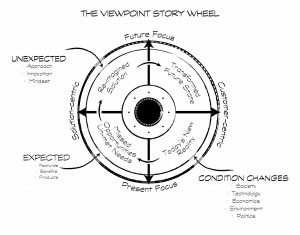
The Viewpoint Story Wheel
Our Viewpoint Story always goes something like this as described on page 68 of Launching to Leading:
- Act 1: One or more things in your world have changed and left you in today’s new reality.
- Act 2: If you depend on the expected solutions X and Y, which were built for the old reality, you will be left with unmet needs and/or missed opportunities.
- Act 3: What if you had an unexpected approach to X that was a re-imagined solution for today’s reality that looked like this.
- Act 4: Then you would end up in a transformed future state where you would solve problems and capture new opportunities in this transformed future state.
We can now build a Purpose or Movement message from extending this framework. Our Movement Message is built by the either cutting out steps 2 and 3, the how of the story, or by focusing strictly on the the transition between steps 3 and 4. Let’s call these type T and type I Movement messages respectively, for Transformation and Inspiration. These paths are shown in this modification of our Story Wheel:
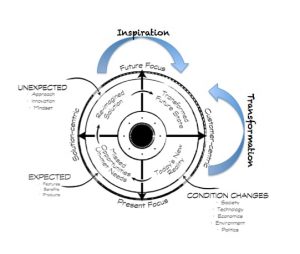
The Viewpoint Paths to Inspiration and Transformation
Now this is all starting to seem a bit theoretical, so let’s take a look at a couple of well know examples, one a which is an Inspirational/Society message and the other a Business Transformation one, Nike and Salesforce.com
Nike – Just Do It, A Inspiration Movement Message
It may not seem obvious, after all of these decades, to not take the Nike Just Do It message as being a Movement starter. Nike though, changed not just an entire industry and but our society with their Movement messaging. Let’s construct the Nike Viewpoint Story –
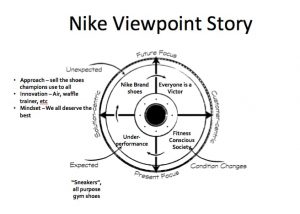
The story goes something like this. Fitness is more important than ever. However, before Nike, we were used to using generic “gym shoes” or “sneakers”, as specialized shoes were the purview of competitive athletes. Nike said, our approach is to sell you the shoes that champions use, we all deserve the innovation and power of the Nike Brand. With Nike, as our name means, everyone is a Victor! Then 17 years after the launch of the Nike brand, they summed the movement up with the inspirational and now ubiquitous slogan, “Just Do It”. Just Do It inspires us to be our own champion, how poetic, beautiful and inspirational. Note, they did not go for the transformational message, which may have been as dull as “From Fitness to Victory…”
Salesforce.com – The End of Software, a Transformation Movement Message
Salesforce.com is one of the business success stories of the last 20 years. Founded in 1999, Salesforce.com now has a market cap of over $50 Billion. They were the first of a long series of Software As A Services successes, and nearly every day in Silicon Valley, you hear the echos of entrepreneurs saying, “we will be the Salesforce of X”. Let’s examine Salesforce.com’s Viewpoint Story – 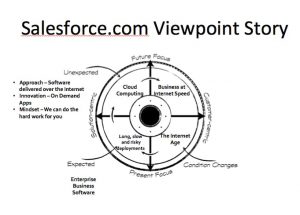
The Salesforce.com story went like this. The world has changed, we’ve entered the Internet Era, and must run our business at Internet speed. (Remember, this was 1999!). However, if we continue to deploy old style Enterprise software, we will be subject to long slow and risky deployments. What if we took an approach where we use the Internet, and “cloud computing” (inserted into the story a few years later) , where your solution provider does the hard work for you? Then you could operate your business at Internet Speed, and win and compete. Salesforce.com summarized this transformation as “The End of Software”. They drove this platform message for more than a decade with their ubiquitous end of software logo. Rather than explain the details, they simply said this!.
We’ve now seen two examples of Purpose or Movement Messaging. In the next post, we will dive deeper into how to build your own Movement Messaging. Until then, here’s another inspirational quote:
Don’t underestimate the power of your vision to change the world. Whether that world is your office, your community, an industry or a global movement, you need to have a core belief that what you contribute can fundamentally change the paradigm or way of thinking about problems. – Leroy Hood, Biologist and Inventor of Automated DNA Sequencing machine
Oct 17, 2016 | Breakthrough Marketing
You have a successful product line, you are a known leader of a meaningful market parade, sales are growing, and so is your valuation. To quote a famous t-shirt brand, “Life is Good”. Congrats.
THEN you raise the big round, make the big acquisition, start to worry about upstarts who are beginning to nip at your heels. Or maybe the sales team needs to call higher, but feel they still are stuck at a functional level in the org. Or maybe the messaging across products is straining for consistency and impact. There must be another step to your mission.
Of course, it’s time to start a movement. Time to say goodbye to your Flashmob and your Market Parade. But Movements are BIG and require new thinking. It’s no longer about value, but it’s still about value. It’s no longer about context or Viewpoint, but it’s still about context. But to reach the next level of market leadership, it’s now about Market Transformation. And to transform the vary market you exist in takes bold new messaging that is above the current context of the market, and seeks to enable and empower , to transform and inspire. And not just your market, but the way we do business or even the society we live in.
In the last section of Launching to Leading, I introduce Purpose Messaging as the key to Igniting a Movement. In the book, I suggest that up to 40% of your messaging in this phase should be dedicated to Purpose Messaging, and use the examples of Salesforce, Google and Zappos to demonstrate this. We also take a look at how Zuora is starting to build a movement. However, the book ends without any real guidance on creating Purpose Messaging. This series of posts are meant to show how to build Movement Messaging.
First, it is helpful to understand the 4 different types of Purpose, or Movement Messaging. Simply put, Movement Messaging can either be focused on Transformation or Inspiration. And it can seek to effect either Business specifically or Society more generally. The four types of movement messaging are Business Transformation, Business Inspiration, Society Inspiration and Society Transformation, as shown in the following diagram:
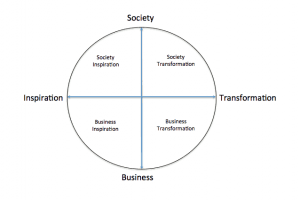
Four Types of Movement Messaging
Let’s take a look at some examples and how they place on this framework. Many of these examples are mixes of the above, but all can be places somewhere on the diagram by weighting their focus.
- Example 1: Salesforce, “The End of Software” – A Business Transformation, enabling the adoption of Software as a Service instead of packaged software.
- Example 2: Zuora, “The Subscription Economy” – A Business Transformation, enabling the move from purchase to leasing, everything!
- Example 3: Zappos – “Delivering Happiness”- A Business Inspiration, you are empowered to focus on happiness first, product and service are secondary to satisfaction
- Example 4: Nike – “Just Do It” – A Society Inspiration, you are empowered to play like a champion
- Example 5: Google – “Accessing the World’s Information” – A Society Transformation, everyone is enabled to find everything
These examples are mapped on our framework here:
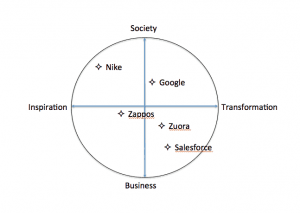
Movement Messaging Example Mapping
As you can see, highly effective Movement Messaging can be built in any of these four quadrants. Movement Messaging is all about purpose, it enables andempowers as it transforms and inspires.
In our next post, we will discuss how to develop your Movement Messaging as a natural extension to our Viewpoint Parade leadership framework. Until then, I leave with this short quote from Zappos Founder Tony Hseih:
“Stop chasing the money and start chasing the passion.”
For part 2 of the series, see here.
