Jan 26, 2019 | Breakthrough Marketing
Many of us just don’t know when to stop. We have product messaging overload. We are so proud of our babies and the myriad of features and amazing benefits we can talk, or write forever. But what we say doesn’t stick!
SO STOP.
Your listener only can remember so many things. There is a reason why phone numbers are only 10 digits long!
Messaging that breaks through needs discipline. Structure can force this on you. Try this simple structural rubric to ensure meaning and breakthrough:
Product Positioning Statement
- Value Statement 1
- Sub-bullet 1
- Feature/proofpoint 1.1 , Feature/proofpoint 1.2, Feature/proofpoint 1.3
- Sub bullet 2
- Feature/proofpoint 2.1, Feature/proofpoint 2.2, Feature/proofpoint 2.3
- Sub bullet 3
- Feature/proofpoint 3.1, Feature/proofpoint 3.2, Feature/proofpoint 3.3
- Value Statement 2 ….
Then repeat the above structure for Value Statements 2 and 3. THAT’S IT!
3 Benefit statements, 3 sub-statements for each, and 3 features for each.
So that’s still a lot, that’s 9 benefits and 27 features.
I’ve always said, messaging and positioning is as much about what you say as what you don’t. Buyers can’t remember more than 9 things about you anyways. The rest is all about filling in detail to support the 3 main bullets, which is the value you deliver that matters most anyways.
One of the reasons you need to spend time doing value filtering like I teach in my LinkedIn Learning course and write about in a whole section of Launching to Leading is to find the right 3 main messages.
So do the hard work, force yourself into this 3x3x3 messaging matrix and you’ll say less, but what you say will matter more and stick much better.
Aug 15, 2018 | Breakthrough Marketing
When I do workshops with clients to build their compelling go to market story, we always start the pre-session survey with what seems like a simple question : “What are the 1 or 2 big picture problems you help customers solve?”
But it ends up really smart teams, whether product teams, technical founders, marketers and even sales execs are really bad at answering this question. In fact, across dozens of engagements and hundreds of answers, I’d give my clients a collective grade of about C-! And that’s mostly because they simply don’t answer the question. So before we think about why they do so poorly, let’s take a look at the typical (poor or wrong) answers that we get, and there are three…
#1 – They confuse what they do with why they do it. Answers like – “We deliver a network based solution that protects this or that with this or that feature.” Or “We give them a xyz with perfect precision”, as if an optician’s answer would be “we give them glasses with the correct prescription”
#2 – They aim too high or too low – They can’t find that sweet spot between not-credible and not-meaningful. Either they say, “We solve world hunger” or “We sweep crumbs off the table”. With one you won’t be believed, with the other no one will care
#3 – They simply don’t know – Answers like a list of features, or a jargon filled ramble or a technical dissertation. While less common, this is often the case.
I think 2 things are going on here. First, they simply lack a structure that helps them formulate the problem statement. Here’s what I use. For WHO, who needs to SOLVE/DO WHAT.
And second and more telling, especially at start-ups, they simply are obsessed with their product. They know the features and benefits, and they know the how, but they don’t spend enough time thinking about the why.
Recently, I partnered with Unusual Ventures as an instructor at their start-up Academy, which is now taking applications. Jyoti Bansal, the founder of App Dynamics and Unusual was quoted last month in Entrepreneur Magazine as saying,
“A lot of people have good ideas — but it’s often those with the best stories who are able to set themselves apart. Turning your idea into a story — one that identifies the need, why it’s imminently important to solve it, why you have the winning solution and why you’re the person to bet on, is key to setting your company up for success.”
But before you can tell your story, the first step is to identify and state the problem you solve. Once you do that, a whole world of possibility opens up to you and your solution.
My problem statement is simple, “I help B2B companies who need to dramatically improve sales and marketing breakthrough and effectiveness in order to capture and grow market leadership.” That’s it. I’d love to help you to find yours, and then spin your story around it. To be a market leader, they first thing you need to do is get an A+ in defining the problem you solve for your customer. C- just won’t cut it.
Jun 6, 2018 | Breakthrough Marketing
I recently read an article in the Harvard Business Review called “The B2B Elements of Value” by Almquist, Cleghorn and Sherer, 3 Bain and Company consultants from San Francisco. It’s a long somewhat complex article with one big take away for me, B2B buyers are people too, and they need to see PERSONAL value to their purchases. That might seem obvious, but all too often I think it’s forgotten. When I do value based messaging work with clients, I always push them to include one more emotional and personal statement in their key value messages, but this is often a tough sell.
The 4 Business Layers
I’ve been writing and talking lot about the 4 layers of Breakthrough Messaging, what I call Mythos to Method. In general, this framework applies to the business story and benefits, not the personal ones. Here’s a quick overview complete with reference links for more on each layer.
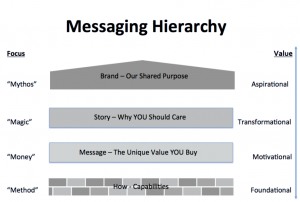
TO LEAD YOUR MARKET, you need 4 “layers” to your message – they start at Method (How) move to Money (Business Value/What) and then to Magic (Transformative Story/Why) then to Mythos (Shared Aspiration).
My new LinkedIn Learning Course covers Method and Money. This is the HOW your product works, and the BUSINESS VALUE delivered, the foundational and motivational layers of your business message. You can watch the 1 hr course here – you’ll need to be a subscriber or get a 30 day free trial on Lynda or LinkedIn Learning
My in-person workshops cover Magic and Mythos. This helps you build your customer’s Hero’s Journey, or how your product magically transforms the business outcomes of your customer. This is the WHY CARE and the shared PURPOSE, the transformational and aspriational layers of your business message. You can see a “lightening” version of this in my Silicon Valley Product Camp 2018 presentation on YouTube here.
My book, Launching to Leading, covers all four layers of framework, you can buy it here on Amazon or anywhere books are sold.
Making It Personal – Another 4 Layers to Add
But, what about the other 4 layers, the personal. It ends up, these layers are just the buyer’s personal version of the other 4. Instead of asking “what’s in it for the business”, we shift our perspective to “what’s in in PERSONALLY for the buyer” at each of these levels. What’s the foundational value of our product? The How. For example, the new agentless endpoint let’s you do updates instantaneously without bothering users. What’s the Motivational Value to the buyer – You are PERSONALLY done with the update in minutes versus weeks, and there are NO mistakes due to out of date agents, the MONEY. What’s the Transformational value, the magic, you are now invisible to users and highly efficient in the eyes of your boss. And the Aspirational destination, a place with protection without disruption, created by YOU.
The Bain study found up to a 6x improvement on NPS score and a 60% improvement on likelihood to repurchase on customers of vendors who communicate both business and persoanl value in their messaging. So, while 8 layers of message may seem like a lot, it can really make a beautiful cake.
Ken
May 15, 2018 | Breakthrough Marketing
I whipped out a quick animation of Prospect Value Journeys. Audio to come soon
May 4, 2018 | Breakthrough Marketing
(NOTE: I was chatting about valuation and messaging with my great friend Susan Thomas and was reminded of this blog I wrote back in 2008 about my very first consulting client Nimsoft. With Cybersecurity, Cloud and other valuations skyrocketing, it’s a really important topic, if you want to get picked up for a big multiple – Ken)
Friday, April 16, 2010
Positioning from Strength
Often I observe that when business is good, positioning gets stale. However, no one cares. As one of my good CFO friends once told me “Top line growth covers a lot of rocks”. I think this is a shame, and a real missed opportunity. Positioning from Strength is a HIGHLY leveragable activity, one that has the potential to accelerate both business and valuation.
Take my client Nimsoft, recently acquired by CA for $350M on a very healthy multiple. When I arrived to work with the CEO, Gary Read and his exec team, business was going great. Nimsoft had (and still has) a tremendous product, great sales momentum and was an execution machine. However, to Gary’s credit, he was open and receptive to a discussion of positioning, vision and go forward marketing strategy, in a way that was highly unusual for a business going so well.
I think Gary saw that Nimsoft was sitting at the apex of an opportunity to reposition from strength, and to use that strength to build a platform and vision that was forward looking and unique. That’s exactly what we did when we launched and implemented the Nimsoft Unified Monitoring strategy, architecture, alliance and .com portal.
The results, well they speak for themselves, great going forward positioning, coupled with continued amazing execution led to continued growth and the CA transaction. But we are not done yet, and this week took the next step with the launch of Nimsoft On Demand, a SaaS delivery of Nimsoft Unified Monitoring. Look for more great things to come from the Nimsoft business now that it is part of CA, this is only the beginning.
So, I think this shows very strongly the value of positioning from strength. CEOs and BODs, don’t wait for the crisis, IF YOUR BUSINESS IS GOING GREAT, and you haven’t examined your GTM positioning and messaging within the last 12-18 months, there’s never been a better time than right now…(Need help, well, I know someone who’s pretty good at this :))…
Jan 29, 2018 | Breakthrough Marketing
Here’s a simple way to think about layering your messaging from brand to product. Think of messaging in 4 layers, brand, story product and differentiation and answering 4 WHYs;
- Why WE exist
- Why YOU should care
- Why YOU should buy
- Why WE are different than the competition
So, what are the answers to these questions?
Why we exist is the world of brand and MYTHOS. Our mission, vision, the mark we want to make on the world.
Why you should care is the world of MAGIC. Make your solution the magic in your Customer’s Hero’s Journey. Who doesn’t want a little magic.
Why you should buy is the world of MONEY. What’s the business value of your solution…
Why we are different is our METHOD or our HOW. It’s our unique capabilities and features.
Sounds easy? Not really. But I started my practice to change the way marketers communicated with their markets after realizing that our old approaches were broken (MYTHOS) And get them focused on story and context to help them transform their brands to market leaders (MAGIC) and get a 6x improvement in Leads to Revenue in 6 months (MONEY) And my METHOD is what I call the Viewpoint Story wheel, my Value Messaging Framework and the like (METHOD).
So, to breakthrough and win, remember you need MYTHOS, MAGIC, MONEY and METHOD to tell a compelling story in the market.
